Rich Natural and Cultural Coastal Heritage in Slovenski vodni krog
The work and research of the Maritime Museum Piran are primarily dedicated to maritime heritage, but this time the sea is explored from a broader perspective. The new season of the TV programme Slovenski vodni krog, broadcast on RTV Slovenija, brings together the Maritime Museum Piran, the Marine Biology Station Piran – National Institute of Biology, the Institute of the Republic of Slovenia for Nature Conservation, the Department of Geology at the University of Ljubljana, and the construction company Žurbi.
Under the direction of Matjaž Mihelčič, the programme explores nature and the ways in which people have coexisted with it over time. The contributors discuss the history of the coastal area, biodiversity, geology and the underwater world, as well as the present-day management of the coastline and human interventions in this sensitive environment.
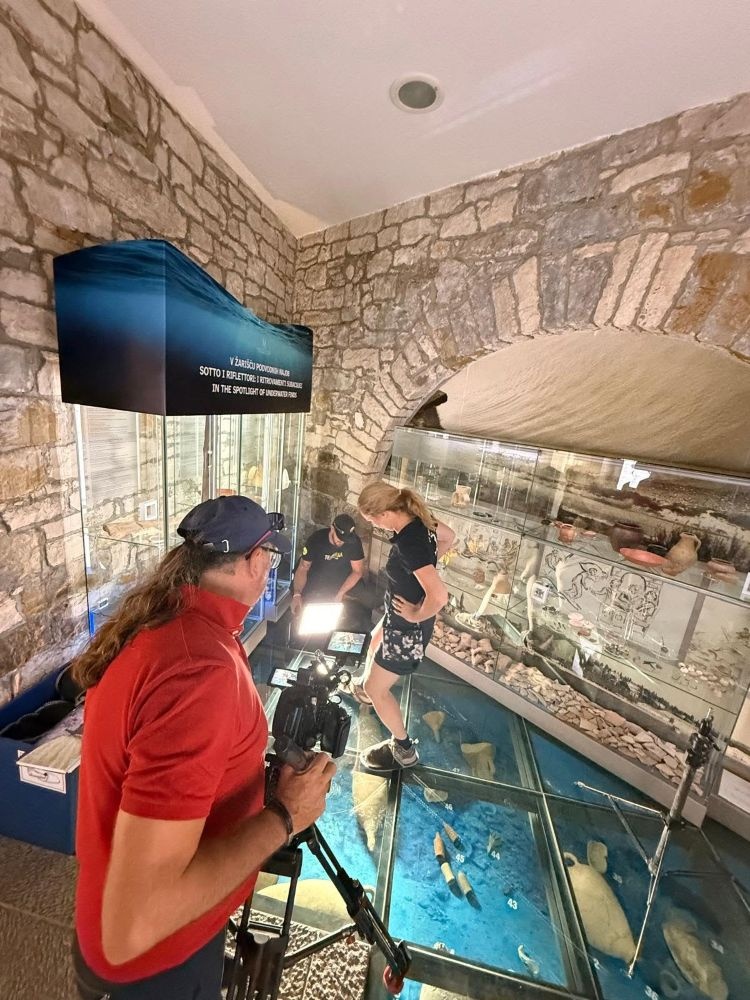
Rising sea levels and specific natural conditions have helped preserve an exceptionally rich history beneath the sea. Roman remains, ancient harbours and submerged landscapes reveal how the coastline and human presence along it have changed over the centuries. The programme will present this heritage through the research and work of the Maritime Museum Piran.
The programme will also show how maritime heritage can be presented through new and innovative approaches. This is one of the objectives of the cross-border project Mala 3ARKA, implemented within the Interreg Slovenia–Croatia Programme 2021–2027, which focuses on the preservation, digitisation and contemporary interpretation of maritime heritage.
At the Sečovlje Salt Pans, home to the Museum of Salt-Making, centuries-old knowledge and traditions will meet modern sustainable solutions. As part of the project, a digital interpretation centre will be established. The site currently has no electricity due to its protected cultural heritage status. In the future, electricity for multimedia and interactive content will be provided by special Mediterranean roof tiles incorporating invisible photovoltaic cells – an innovative solution also used in Pompeii.
From the Sečovlje Salt Pans and a landscape shaped by centuries of human activity, the programme ultimately returns to nature and the sea – a space of balance between nature and people, tradition and innovation, the past and the future.
Stay tuned!